Umar ibn al-Khattab (RA) and the Night Patrol
A Glimpse into Servant-Leadership in Islam
Leadership in Islam was never about titles or status — it was about service, sacrifice, and sincerity. One of the most vivid illustrations of this can be seen in the life of Umar ibn al-Khattab (رضي الله عنه), the second Caliph of Islam.
The Night Patrol: Seeing with His Own Eyes
During his caliphate, Umar would often walk the streets of Madinah at night, disguising himself to observe the real condition of the people. He didn’t rely on reports or intermediaries — he sought to witness the truth himself. This was his way of holding himself accountable before Allah and fulfilling the trust of leadership.
A Mother’s Desperation: A Caliph’s Response
In one famous account, Umar (RA) came across a woman cooking water and pretending it was food to comfort her crying children, who were starving. The mother had no idea she was speaking to the Caliph himself when she complained of injustice. Umar, deeply moved, rushed back to the treasury, carried a sack of flour on his own back, and personally prepared food for the family.
“Will You Carry My Burden?”
When asked why he didn’t allow a servant to carry the sack, he replied, “Will you carry my burden on the Day of Judgment?”
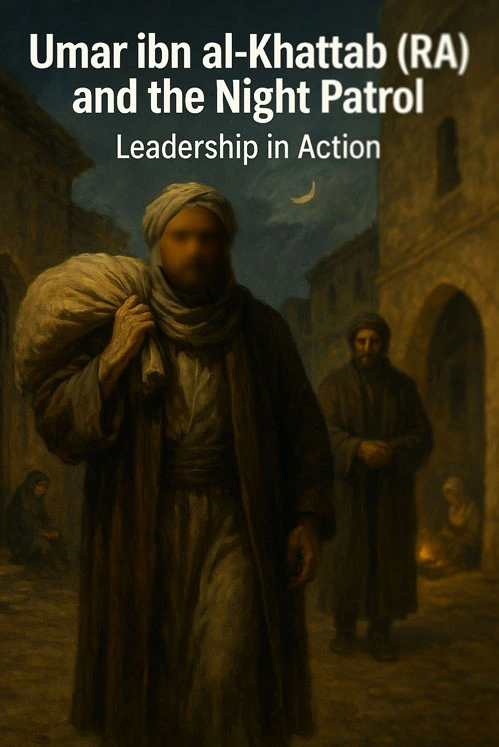
That single line reframes the entire story. Umar wasn’t refusing help out of stubbornness or performance — he understood the sack of flour as something more than physical weight. It represented a failure of leadership that had reached a starving family under his watch, and he treated the discomfort of carrying it himself as a small, appropriate price for having let that failure happen at all. Delegating the task away would have meant delegating the accountability too.
Lessons in Accountability and Humility
This story isn’t just about compassion. It’s about accountability, humility, and servant-leadership — principles deeply rooted in Islamic governance. Umar ibn al-Khattab (RA) showed that a true leader is one who loses sleep for the sake of others, who walks among the people rather than staying insulated from them, and who fears Allah more than the loss of political power or public image.
Reframing Leadership: From Privilege to Burden
In a time when leadership is often associated with privilege, status, and comfort, the example of Umar (RA) reminds us that real leadership is a burden, not a benefit. It is not about being served, but serving — especially the most vulnerable, and especially when no one is watching to notice the effort.
A Timeless Principle
“Every shepherd is responsible for his flock.” (Prophet Muhammad ﷺ)
Umar’s night patrol is that principle made visible — not a shepherd who simply claims responsibility for the flock, but one who actually walks out at night to check on it, disguised, unannounced, and unwilling to take anyone’s word for how things really stood.