
Time Blocking with Barakah: 5 Powerful Habits for Ultimate Productivity
Time Blocking with Barakah: A Muslim’s Guide to Productive Days
Productivity in Islam isn’t about cramming more into your day — it’s about living with intention, purpose, and barakah (blessing) in your time. One of the most effective methods to achieve this is through time blocking — but with a faith-based twist.
This post is about the whole-day scheduling method specifically. If you want the exact morning ritual instead, see our Morning Routine Sunnah guide or Barakah in the Early Hours, and if it’s the quality of your prayer itself you want to work on rather than when it happens, see Mindful Prayer.
What Is Time Blocking?
Time blocking is a method where you divide your day into chunks and assign each block to a specific task or focus area — like Qur’an recitation, deep work, exercise, or family time. It’s not multitasking — it’s focused time with a clear purpose.
Add Barakah to Your Blocks
As Muslims, our barakah flows from aligning with what pleases Allah ﷻ. That means anchoring your schedule around salah times, rest, remembrance, and intention, rather than treating prayer as an interruption to work around.
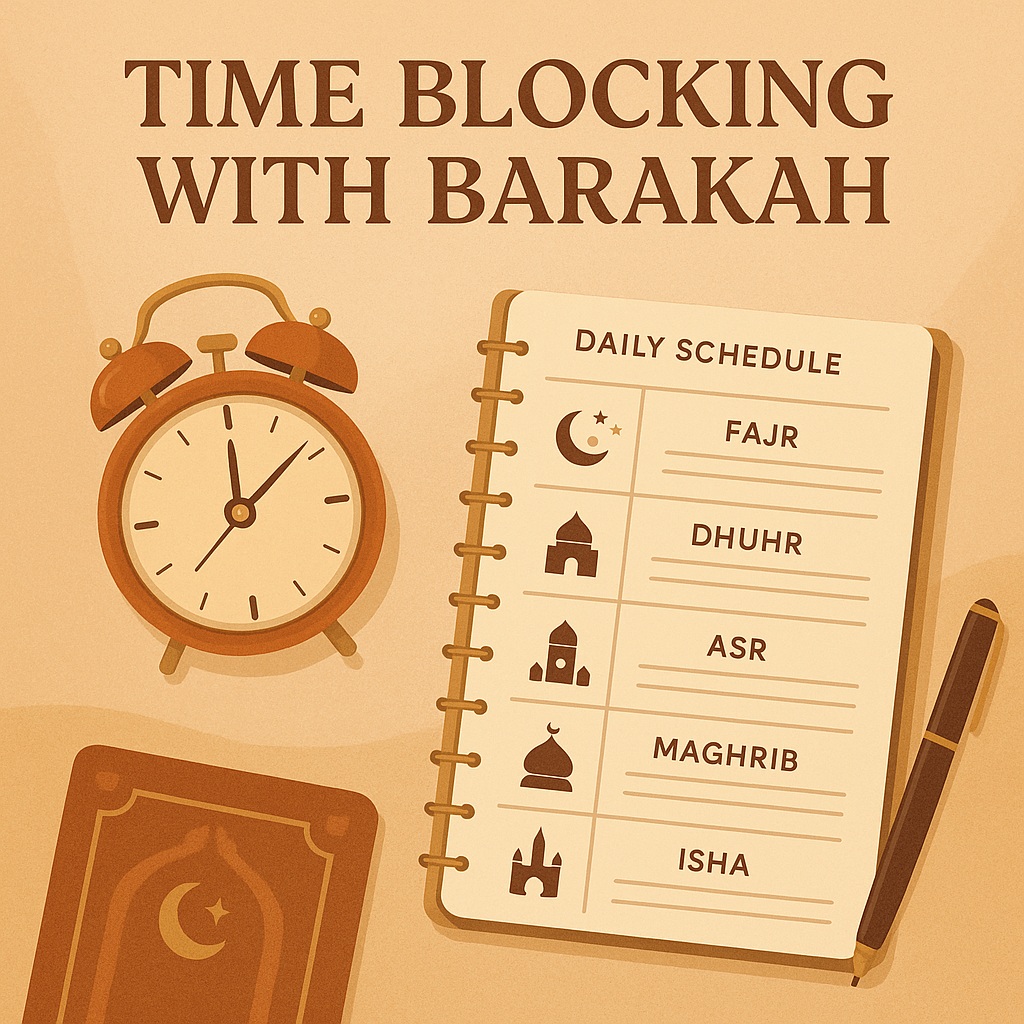
Why Anchoring to Salah Changes the Method
Conventional time blocking treats the day as a blank grid you impose structure onto from scratch. This version starts from a structure that already exists — the five daily prayers — and builds the rest of the day’s blocks around those fixed points instead of squeezing prayer into whatever gaps are left over. That’s a meaningfully different planning approach: instead of asking “when can I fit in Dhuhr today,” the day is designed so Dhuhr is already a fixed anchor, and everything else is scheduled with that anchor as a given. Our Prayer Times Calculator makes this practical, since you need the actual prayer times for your location before you can anchor blocks around them.
Example: A Barakah-Based Daily Time Block
- Fajr → Spiritual Start (Prayer, Qur’an, Du’a)
- Morning Block (Deep work or learning)
- Dhuhr → Midday Reset (Salah + light task)
- Lunch & Break
- Asr → Focused Admin / Family Tasks
- Maghrib → Reflection (Short study, journaling, connection)
- Isha → Wind Down (Dhikr, intention for tomorrow, early rest)
Tips to Increase Barakah
- Start each block with “Bismillah” — a small habit that reframes even ordinary work as something begun with Allah in mind.
- Set your intention: “Ya Allah, I want this time to benefit me in dunya and akhirah.”
- Use a physical or digital planner that includes prayer times, rather than a generic calendar that treats salah as just another appointment.
- Don’t just plan — make du’a for barakah in your time, since the planning itself doesn’t guarantee the blessing; the intention behind it does.
Final Reflection
When time is used mindfully, with Allah at the center, it multiplies. What you do in two hours with barakah may exceed ten hours without it. If you want to build this rhythm into a sustainable daily habit rather than a one-off planning exercise, our Islamic Time Management guide covers the broader principles behind it, and our Prayer Tracker can help you keep the prayer anchors themselves consistent day to day.
Start blocking time not just for productivity, but for purpose.





Good tips.