Hadith on simplicity in living.
Arabic Hadith:
عَنْ عَائِشَةَ رَضِيَ اللَّهُ عَنْهَا قَالَتْ:
«إِنْ كَانَ رَسُولُ اللَّهِ ﷺ لَيَمُرُّ الْهِلَالَ، ثُمَّ الْهِلَالَ، مَا يُوقَدُ فِي أَبْيَاتِ رَسُولِ اللَّهِ ﷺ نَارٌ»
قَالَتْ: قُلْتُ: يَا خَالَةُ، فَمَا كَانَ يُعِيشُكُمْ؟
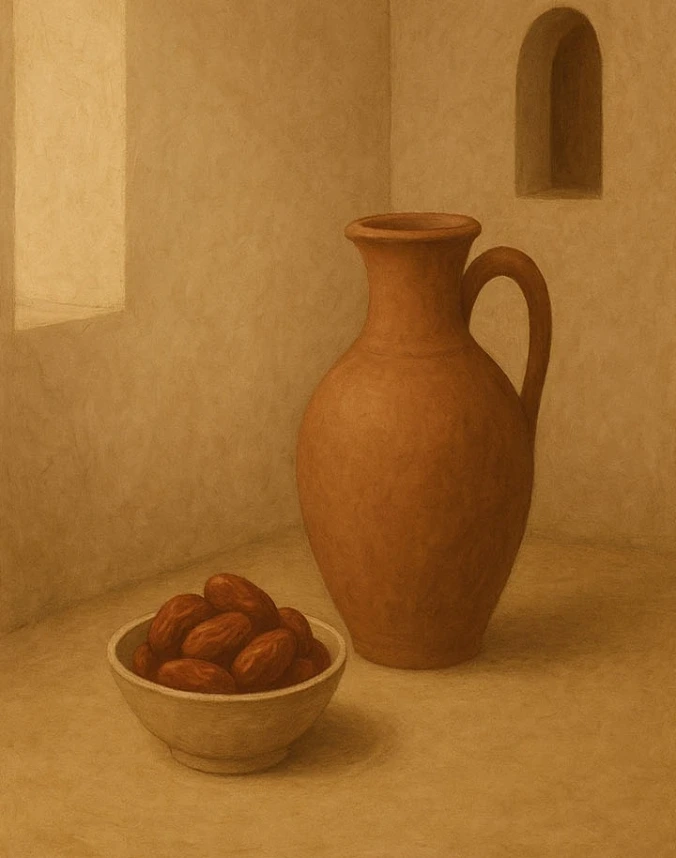
قَالَتْ: «الْأَسْوَدَانِ: التَّمْرُ وَالْمَاءُ»
— رواه البخاري
Translation:
Narrated Aisha (رضي الله عنها):
“Three new moons would pass, and no fire (for cooking) would be kindled in the houses of the Messenger of Allah ﷺ.”
She (Aisha) said, “I asked: O Aunt! Then how did you survive?”
She said: “By the two black things — dates and water.”
— Sahih al-Bukhari
Context and Meaning
“Three new moons would pass” refers to entire months where no cooking fires were lit in the Prophet’s household. This wasn’t occasional fasting, but extended periods of having no cooked food whatsoever — a detail worth sitting with, since it describes months, not days.
“The two black things” (الأسودان) refers to dates and water — dates being dark when dried, and water appearing dark in vessels or drawn at night. This was their entire sustenance during these periods, not a description of frugal but varied meals.
Historical Significance
This hadith illustrates the extreme simplicity of the Prophet’s household, even after establishing the Muslim community in Medina. Despite being the leader of a growing community, the Prophet ﷺ lived in voluntary poverty, prioritizing the welfare of others over his own comfort. The phrase “houses of the Messenger of Allah” (plural) refers to the modest dwellings of his wives, showing this was the condition across his entire household, not just one residence.
What makes this especially notable is the timing: this wasn’t the condition of a struggling, powerless community in its early, persecuted years in Makkah. This was after Madinah, after victories, after the establishment of a functioning state with real resources passing through it. The simplicity wasn’t circumstantial — it was chosen, maintained even when a very different standard of living would have been entirely available.
What Zuhd Actually Means
It’s worth being precise about what this hadith is and isn’t describing. Zuhd (asceticism in the Islamic sense) isn’t a rejection of wealth as inherently bad, and the Prophet ﷺ didn’t forbid comfort or provision to others — he distributed wealth, encouraged trade, and never taught that poverty itself was virtuous. What this hadith describes is a specific personal detachment: the ability to have access to more and consistently choose not to hold onto it, prioritizing others’ needs and simplicity of living over accumulation, even when accumulation was available.
Reflection
This hadith offers a powerful reminder of the Zuhd of the Prophet ﷺ. Despite being the best of creation, his life was marked by contentment, humility, and simplicity.
In an age of abundance and constant craving for more, this prophetic example calls us to reconnect with gratitude and to live within our means, focusing more on spiritual wealth than material possessions. Let us reflect on how we can simplify our lives, appreciate what we have, and embody the noble character of the Prophet ﷺ in our daily choices. Our guide to creating a halal budget is a practical starting point if this reflection has you looking to actually restructure your spending toward these values.