Zakat al-Fitr: The Complete Guide to Beautiful Blessings & Rules
Zakat al-Fitr — also called Fitrana or Sadaqat al-Fitr — is a charity every Muslim owes at the end of Ramadan, separate from and in addition to Zakat al-Mal (the annual zakat on wealth). It’s easy to confuse the two, or to assume “I already paid zakat this year” covers it. It doesn’t. This guide walks through what it is, who owes it, how much, and when — if you’re looking for country-specific amounts, we cover those separately in our Zakat al-Fitr Amount guide.

What Is Zakat al-Fitr?
Zakat al-Fitr is a small, fixed charity given by every Muslim before the Eid al-Fitr prayer, marking the end of Ramadan. Its purpose is twofold: it purifies the fasting person from any shortcomings, idle talk, or minor faults committed during the month, and it ensures that even the poorest members of the community have enough to celebrate Eid without needing to ask for help.
Unlike Zakat al-Mal, Zakat al-Fitr isn’t based on how much wealth you hold — it’s a fixed amount owed per person, rich or poor, as long as you have food beyond your basic needs for Eid day.
Zakat al-Fitr vs. Zakat al-Mal — What’s the Difference?
| Zakat al-Fitr | Zakat al-Mal | |
|---|---|---|
| When | Once a year, before Eid al-Fitr | Once a lunar year, whenever your wealth has been above nisab for a full year |
| Based on | A fixed amount per person | 2.5% of your zakatable wealth |
| Who owes it | Every Muslim with food beyond basic needs, including children (paid by parents) | Only those whose wealth meets the nisab threshold |
| Purpose | Purifies the fast; ensures the poor can celebrate Eid | Purifies wealth; redistributes to the eight eligible categories |
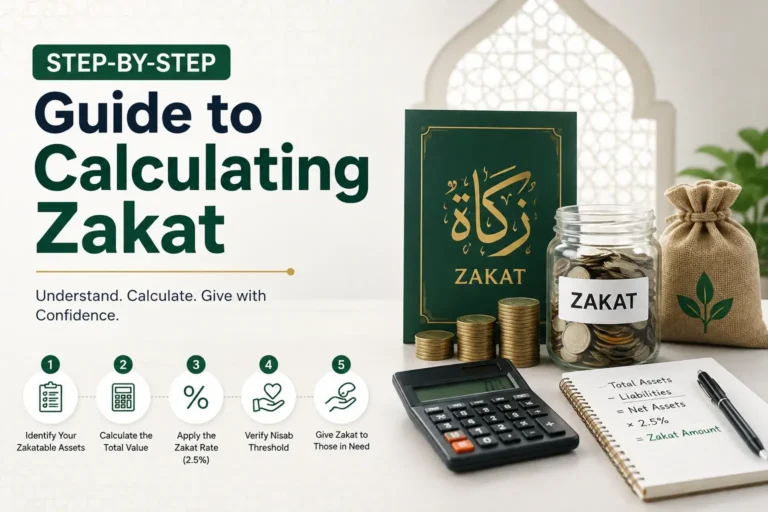
Paying one does not exempt you from the other — most Muslims who qualify for Zakat al-Mal end up paying both across the year. Our Step-by-step Guide to Calculating Zakat covers Zakat al-Mal in detail if you haven’t worked through that one yet, and our Zakat Calculator handles the 2.5% calculation for you.
Who Must Pay Zakat al-Fitr?
Zakat al-Fitr is owed by:
- Every adult Muslim who has food surplus to their needs and their dependents’ needs for the day of Eid
- Children — paid on their behalf by a parent or guardian
- The head of household, on behalf of everyone they financially support (spouse, children, and in many scholarly views, other dependents living in the home)
Unlike Zakat al-Mal, there’s no nisab threshold to clear — the bar for owing Zakat al-Fitr is simply having enough food for your household on Eid day, which in practice means nearly every Muslim owes it.
How Much Is Zakat al-Fitr?
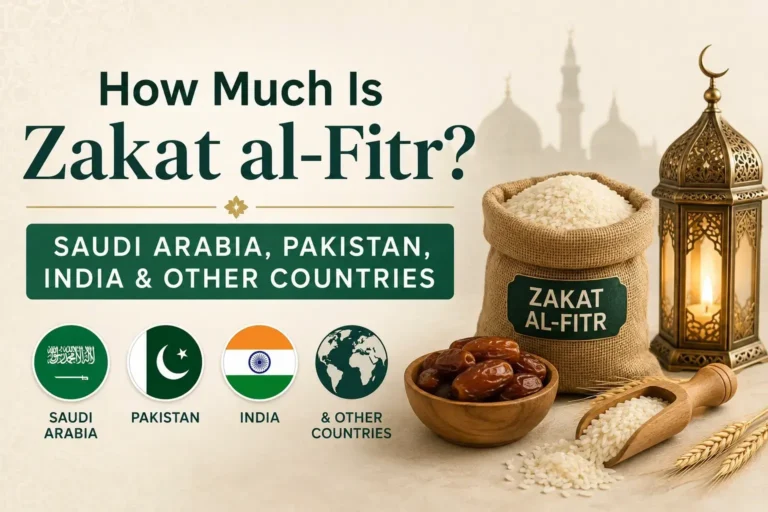
The traditional measure is one Saʿ of a staple food — approximately 2.5–3 kg of wheat, barley, dates, raisins, or rice (or your local staple). Most Muslims today pay the cash equivalent of that amount rather than handing over the physical food, which the majority of scholars permit for ease of distribution.
Because the cash value depends on current staple food prices, it varies by country and shifts slightly year to year. We keep specific, regularly-updated amounts for Saudi Arabia, Pakistan, India, and a general calculation method for anywhere else in our Zakat al-Fitr Amount guide — that’s the page to check for this year’s actual number.
When Should Zakat al-Fitr Be Paid?
Zakat al-Fitr has a specific window:
- Earliest: Many scholars permit paying it a few days before Eid, so charities have time to distribute it before the celebration begins.
- Best time: The morning of Eid, before the Eid prayer.
- Deadline: Before the Eid prayer begins.
If it’s paid after the Eid prayer, it no longer counts as Zakat al-Fitr — it’s treated as ordinary voluntary charity (sadaqah) instead. This is one of the most common mistakes people make, so if you’re going to pay it yourself rather than through a mosque or organized charity, mark a reminder a few days before Eid rather than leaving it to the morning of.
Who Receives Zakat al-Fitr?
Zakat al-Fitr is distributed to the poor and needy, following the same broad recipient categories as Zakat al-Mal. Most people give through a local mosque or a trusted Islamic charity, which pools contributions and distributes them before Eid — this is generally simpler and more reliable than trying to identify and pay eligible recipients individually, especially given the tight timing window.
Common Mistakes to Avoid
- Paying it too late. Once the Eid prayer starts, it converts to regular sadaqah — plan a few days ahead instead of leaving it to Eid morning.
- Forgetting dependents. Zakat al-Fitr is owed per person, not per household — a family of five owes five portions, not one.
- Assuming Zakat al-Mal covers it. They’re separate obligations with separate calculations; paying one doesn’t fulfill the other.
- Using an outdated amount. Because it’s tied to food prices, last year’s figure may not match this year’s — check a current source rather than reusing an old number from memory.
Frequently Asked Questions
Do I owe Zakat al-Fitr if I’m not wealthy?
Yes, as long as you have food surplus to your basic needs for Eid day — there’s no wealth threshold like there is for Zakat al-Mal. Most Muslims owe it regardless of income level.
Can I pay Zakat al-Fitr in food instead of cash?
Yes, and it’s considered the more traditional approach — giving roughly 2.5–3 kg of a staple food directly. Most scholars also permit the cash equivalent for practicality, which is what the majority of mosques and charities collect today.
Do I pay Zakat al-Fitr for a baby or newborn?
Yes — Zakat al-Fitr is owed on behalf of every member of the household, including infants, paid by the parent or guardian.
What if I can’t afford to pay it?
If you genuinely don’t have food surplus to your household’s basic needs for Eid day, the obligation doesn’t apply to you. It’s meant to be manageable — the fixed, modest amount is intentionally set at a level most people can afford.
Ready to check this year’s amount for your country, or calculate your annual Zakat al-Mal? See our Zakat al-Fitr Amount guide or head to the Zakat Calculator.
May Allah accept your Zakat al-Fitr and grant you and your family a blessed Eid. Ameen.